
My Philosophy of Drawing

Daniel Haskin’s drawing practice operates at the intersection of Symbolist tradition and contemporary psychological inquiry. His work is driven by an interest in how interior experience—memory, instinct, emotional history—can be made visible through symbolic and surreal imagery. Across human figures, birds, and botanical forms, Haskin constructs a visual language that treats each subject as part of a larger system of meaning rather than as an isolated object.
Graphite serves as the foundation of this system. Its tonal subtlety allows Haskin to explore ambiguity, layered identity, and the quiet shifts that occur within the psyche. Gold leaf functions as a deliberate interruption, marking points where the unseen asserts itself. In his work, gold is not decorative; it signals moments of clarity, rupture, or transformation. The contrast between graphite and gold becomes a structural device for examining how internal states break through the surface of representation.
Haskin’s symbolic vocabulary—embedded faces, avian figures, botanical growths—extends the human psyche into multiple forms. Birds, for example, are not treated as naturalistic subjects but as psychological agents. They embody vigilance, transition, and the tension between vulnerability and authority. Botanical forms operate as metaphors for emotional development and the nonlinear pathways of memory. These symbols allow Haskin to articulate aspects of consciousness that realism alone cannot express.
His approach is informed by several key artists from the Symbolist movement, whose work provides historical grounding for his own investigations. Gustav Klimt offers a precedent for using gold as a conceptual marker of revelation and inner significance. Odilon Redon demonstrates how dreamlike imagery can express psychological truth, a strategy echoed in Haskin’s embedded faces and surreal intrusions. Fernand Khnopff provides a model for introspective stillness and the depiction of multiple selves, aligning with Haskin’s interest in interior multiplicity. Edvard Munch, though not strictly Symbolist, contributes an understanding of emotional intensity and the expressive potential of gesture. Félicien Rops shows how surreal distortion can reveal underlying tension rather than escape reality. These influences collectively reinforce Haskin’s commitment to symbolic form as a means of exploring interior life.
The surreal elements in Haskin’s drawings are not oriented toward fantasy. Instead, they reveal hidden dimensions of lived experience. His work aligns with a Surrealist methodology in which realistic rendering is juxtaposed with symbolic intervention to expose the mechanisms through which identity is formed, fractured, and reconstituted. This approach supports a contemporary understanding of the self as layered, shifting, and shaped by unconscious processes.
Ultimately, Haskin’s drawings propose that the self is not singular but composite. Human figures, birds, and symbolic forms function as interconnected components of a broader interior landscape. Through careful material choices and a consistent symbolic vocabulary, Haskin creates images that invite viewers to consider their own psychological architecture. His work does not offer definitive interpretations; instead, it creates openings—spaces where the visible and invisible meet, and where viewers can recognize the complexity of their own inner world.
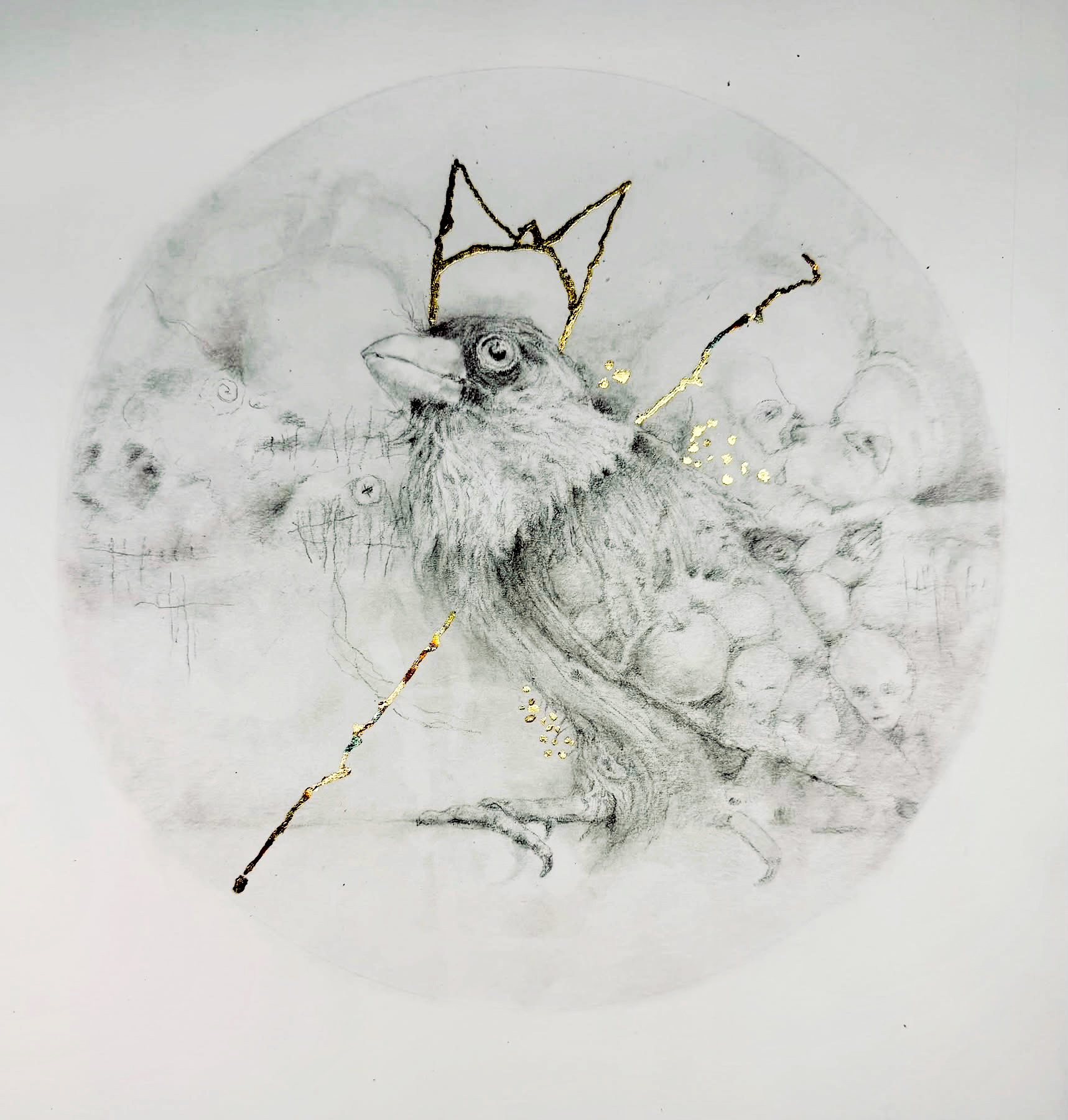 This drawing presents the bird as symbolic rather than a simple natural subject. Its carefully rendered form carries a sense of vigilance and interior weight, while the gold crown and diagonal gilded line introduce a language of interruption and revelation. The faint human faces and skull-like forms emerging in the background suggest the presence of memory, ancestry, or unseen psychological forces that accompany the central figure. By combining precise graphite realism with subtle surreal intrusions, the piece explores how instinct, identity, and inner history coexist within a single image. The bird becomes a mediator between the visible world and the symbolic one, holding both with quiet authority.